
What do you do when stuck?
I often ask clients what they do when stuck—when they’re dragging their feet on a task, or mentally depleted, or procrastinating, or constantly seeking distractions. What do you do in those situations?
Let’s get more specific: think of a task you’ve been procrastinating on or a recurring task you always resist doing. What do you think you could or should do to work through that and do the task? Give this some thought and write your ideas down somewhere if you can.
The most common answer I get from clients is to take a break—they might go for a walk or run, have a snack, or do a workout. Does it help? A little, sometimes. It will probably give you a bit more mental energy, but it won’t do much more than that. Will taking a walk make you ready to dive into a task you were procrastinating on? Probably not.
The problem: We’re missing a useful productivity framework
Here’s the problem with that strategy: it isn’t targeting the source(s) of the productivity struggle. In order to target the source(s), we’d need: (1) Understanding of the factors that cause these productivity struggles, (2) a tool for identifying which factors are at play when facing a particular productivity struggle, and (3) sets of techniques that target these specific factors.
We need a comprehensive and actionable framework that does these things. But instead all you can find online or in books is endless lists of superficial productivity tips and tricks. All those tips are just noise when not rooted in a clear understanding and framework.
ADHD minds suffer the most without a useful productivity framework
The problem with not having a useful productivity framework is most visible at the extreme ends of productivity struggles. Most people can push through their work and get by without a productivity framework (though using brute force to push through your work wears on you and often results in burnout in the long-run).
But if you’re like me and have struggled to get through school and work with ADHD, you know that we need a better way. The generic task and time management advice doesn’t help most people and it’s definitely not enough for our ADHD minds. Yet that’s still the most common productivity advice for people with ADHD.
The solution: The Productivity Controls Framework
Before learning more productivity techniques, you need a framework that organizes them. I’ve spent the past 7+ years distilling all of the productivity techniques into a simple framework with 4 core factors.
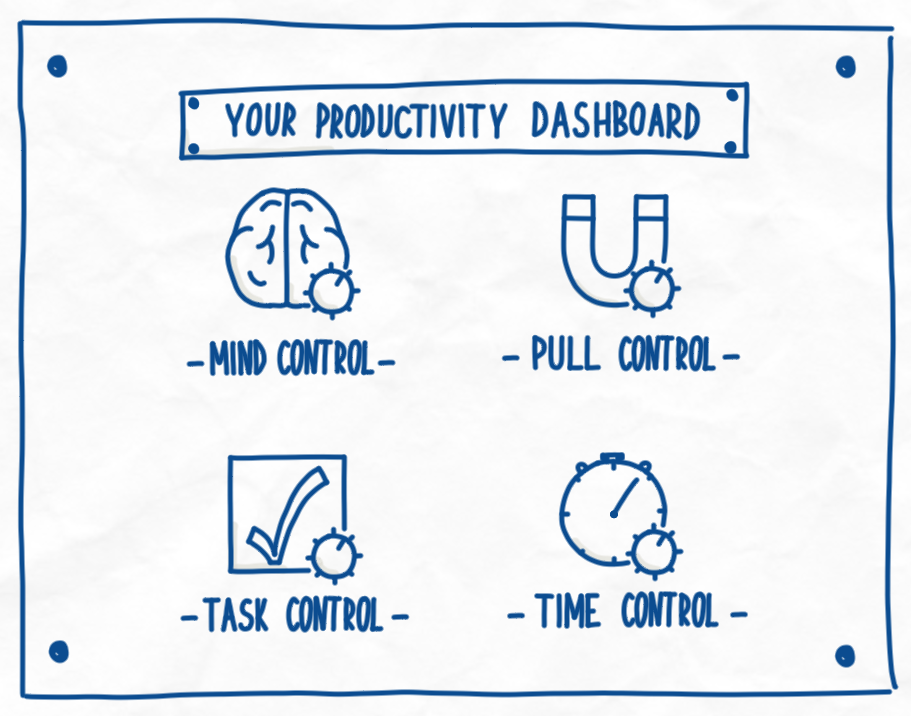
This framework essentially says that you need a productivity system that makes it easier for you to manage your…
- 🧠 Mind (e.g., mental energy, thoughts, stress)
- 🔎 Tasks (how you organize and break down tasks)
- ⏳ Time (using a time planning technique that decreases wasted time)
- 🧲 Pulls (feeling excitement and eagerness towards tasks you “should” be working on)
Different productivity techniques fall into one or more of these categories. For example, creating to-do lists would fall under task management. Stress management techniques would fall under mind management.
I refer to these as your Productivity Controls: Mind Control, Task Control, Time Control, and Pull Control. In my one-on-one and group coaching sessions, this Productivity Controls Framework is the foundation of our work.
This framework is also more than just a list of disconnected topics. The Productivity Controls are all connected in the psychological functions they serve and, together, I believe they form a comprehensive framework.
Here’s my bold claim: I believe that any productivity struggle can be understood and addressed through techniques that strengthen one or more of these Productivity Controls.
Note: This article describes the 4 productivity factors as Productivity “Controls”: Mind Control, Task Control, Time Control, and Pull Control. I now usually use “Management” instead of Control (e.g., Mind Management, Task Management, etc.), though the factors themselves are the same.
Try it Out
Think of that task you’ve been procrastinating on or resisting—one that makes you do a mental cringe when you think about it. Now let’s try to identify which of the Productivity Controls are holding you back on that task.
For each of the following, we want to get a sense for how high or low you are on that factor. One option is to respond to the following questions with high, medium, or low. Or, I find it more intuitive to think: good, ok, low. Go with whatever makes sense to you.
Go ahead and think of how high or low you are on the following factors for the task you’re procrastinating on.
- 🧠 Mind Control: Do you have the mental energy needed to get to work on, and complete, the task?
- 🔎 Task Control: Does the task feel easy to get started on?
- ⏳ Time Control: Have you budgeted a specific amount of time for the task?
- 🧲 Pull Control: Do you have an angle for doing the task that excites you?
Which of the Productivity Controls were you low on? There’s a good chance you were low on all or most of them for a task that you’re procrastinating on. Think back to your original ideas for working through your struggles. Which of these Productivity Controls would your ideas have helped with? Does that align with which Productivity Controls were low and needed the most attention?
Four Toolboxes
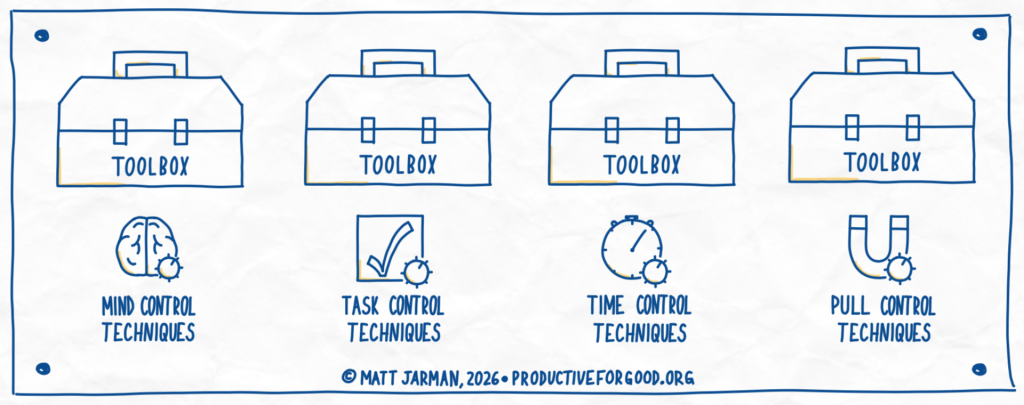
Most productivity discussions focus on techniques, when what you really need is to first identify what’s holding you back. That’s what you just did with the 4 Productivity Controls. Once you know which are low, then you can look for techniques that will increase those particular Productivity Controls.
I give clients a different toolkit of techniques for each of the 4 Productivity Controls. The key is that the right technique depends on which Productivity Control is low — using a time management technique when you’re actually low on Mind Control, for example, won’t help much. When you actually understand the sources of your productivity struggles, you know which techniques are likely to help.
Conclusion
Do you see why the Productivity Controls Framework is so important? Without it, you’re relying on chance to stumble across a technique that will help.
This isn’t the sort of thing where next week I’ll introduce another framework and then another. The Productivity Controls Framework is the one core productivity framework that I always come back to, no matter your productivity struggles, and particularly if you have ADHD.
This framework is one of three essential pieces of my productivity approach. In the next two articles, I’ll introduce you to the other key pieces:
1 Productivity Framework- 1 Productivity Habit
- 1 Productivity Mindset
Want to put this into practice? Take a look at my Productivity Dashboard program—a self-paced mini-course that walks you through identifying your levels on all 4 Productivity Controls and gives you a sample technique for each.