
Your brain’s just trying to help… by getting in the way of your work! Once you understand why, you’ll get an idea of how you can turn your brain into your biggest ally.
Two Things to Know
When you’re trying to complete a task and struggle with obstacles such as boredom, fatigue, resistance, and distraction-seeking, there are two things to understand about what’s happening:
- Your brain is actively trying to stop you from continuing to work on the task.
- Your brain is actively trying to help you.
Your Brain is Similar to a Child
The two points above seem contradictory, but they aren’t. I sometimes compare the brain to a young child. If you told a child you were working on tasks that you didn’t find particularly fun and really preferred not to do, the child might offer you the sage advice to just stop doing those tasks.
This is actually good advice if you’re focused on your short-term well-being. But the advice isn’t helpful for reaching long-term goals that involve unpleasant tasks along the way.
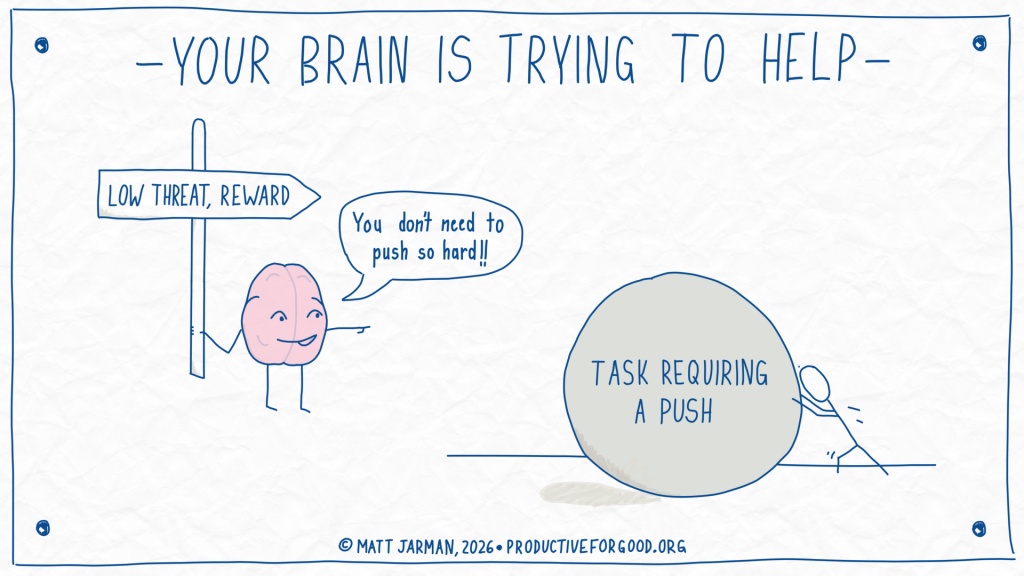
Unfortunately, your brain is more focused on immediate threat detection and short-term rewards than on long-term goal fulfillment. Research suggests, for example, that your brain evolved to make you feel boredom and mental fatigue when you’ve been working on a high-effort, low-reward task for a while. Why would it do this? To put the brakes on the current activity, so that you’re likely to find another activity that’s more fruitful. Your brain is basically telling you “Hey, this doesn’t seem to be getting us anywhere—let’s try something else.”
In addition, when tasks are also accompanied by fears (e.g., related to work quality, what others will think, etc.) and other emotional baggage, it interprets those as threats to be avoided.
Show Some Gratitude
Before you get upset at your brain for intervening in this way, take a moment to consider how strange your actions seem to your brain. You spend a ton of time on unpleasant—often stressful—tasks with little short-term reward. This wouldn’t make a lot of sense to a young child and it doesn’t make a lot of sense to your brain. So it’s doing what it can to protect you from yourself, to get you on a better path.
I often say I try to help people team up with their brain. The first step to doing so is to remember that it’s trying to help. It’s hard to work with teammates if you’re upset at them, so send some gratitude towards your brain. We can express gratitude for the intention to help, even if we don’t like how it’s trying to do it.
When you notice your brain trying to get you to stop your current task (e.g., through boredom, distractions, etc.), I recommend that you think to yourself, “Thanks for trying to help, but I want to keep working on this; it will allow me to _______ [insert goal]”. This way, you’ve acknowledged the message your brain’s sending you, communicated to it that this task poses no threat, and essentially told it there is a reward to completing this.
Get in Alignment with your Brain
How do we make changes so that our brain doesn’t try to stop us from doing our work? By decreasing the amount of cognitive pushing required to complete the tasks. We do this by some combination of increasing our available executive function and decreasing the executive function demands of the tasks. Techniques for managing your mind do the former and techniques for managing your tasks and time do the latter.
But teaming up with your brain is more than getting your brain out of the way—it’s getting your brain to help you do better work. This is where managing task pull is important. If you feel a pull—an eagerness—to do a task, your brain will be excited to direct cognitive resources towards it. This is why you’ll sometimes want to find creative ways to feel a genuine pull towards some tasks. This is a topic I’ll frequently return to in the future.
Conclusion
I like to picture brains throwing their hands up with exasperation, saying “Not again, when will they learn to pick better tasks?! I’ll do my best to get them out of this mess, again!” Your brain is trying to help in the only way it knows how. It needs your guidance to help in a manner that still allows you to achieve your work goals.
Put simply, if you decrease the amount you need to push through your work, your brain will intervene less. Increase the pull you feel and your brain will actively help you reach your full work potential—that’s when you and your brain start acting like a team.